

Victoria likes dragons and she likes spinning wheels. I have the privilege of combining these two loves into what will hopefully be a wonderful new wheel. I couldn’t resist the temptation to start with the figurehead. Victoria had already named him Henry and that gave me a sort of a direction to travel. She also likes whimsy and didn’t want a fire breathing beast anywhere near this wheel. Henry likes to read, according to Victoria, and she informed me that his favorite book is “Knitting for Dragons.”

Henry is near-sighted and needs spectacles to read. He doesn’t really look mad – he’s just concentrating. My daughters collaborated on helping Henry with his wardrobe so he is sporting a little knitted cape and a great little hat.

Here he is from the side without his clothes. You might notice a ball of yarn and knitting needles below his book. This little fellow will be removable so when Victoria is done spinning, she can take Henry along with her to her favorite place to knit. Or perhaps she’ll pick up her own bigger copy of “Knitting for Dragons.”


A lot of progress has been made on the new wheel and several spinners have been looking forward to seeing the Great Pyrenees carving. I was too! Each carving I do is truly an adventure as my background is landscape painting with just a dash of wildlife thrown in. Carving is a new undertaking and I always wonder if I’ll be able to pull it off. Since Ann’s reference photos were limited, I had to find a similar dog in our area. There is a great new farm a few miles from us and I’ve noticed a big white dog tending the sheep and chickens. I called the nice folks at the farm and explained my mission and they graciously let me shoot photos of their dog. Brina proved a wonderful model and she gave me the poses I needed. She was friendly and playful and yet she always had an eye to the sky. Turns out she’s always watching for eagles that could prove an unwelcome threat to the flocks.
The new handle configuration I use these days allows me to pose a carving a bit away from the spinner and this keeps the actual handle part smooth and easy to lift. And the dog can just lay around and keep one eye on the spinner! I carved some dog tracks into the toe end of the treadles too and it helps carry the theme to the far reaches of the wheel. The wood is cherry and there will be a few walnut accents. Enjoy!
 I
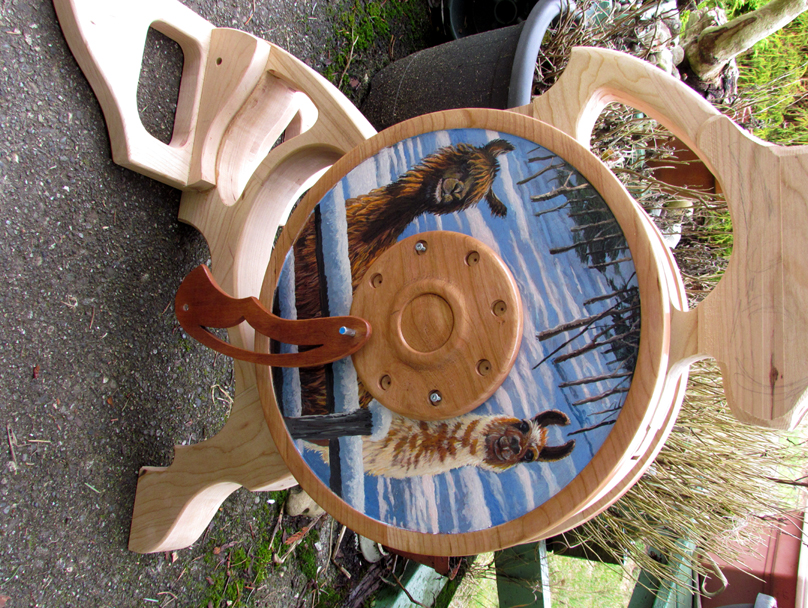
II have always enjoyed llamas and finally I’m getting my chance to do a llama wheel! This spinner wanted me to paint her four llamas on the large wheels and this is the best I’ve come up with considering the limitations of the space. Above the wheels will be a carved handle and it will be a portrait of her Great Pyrenees dog. In addition to the four photos she sent, I got some of my own reference by visiting a local fiber farm and photographing their own dog. This wheel has a long way to go but I think it is a good start and I am happy to post these preliminary pictures.

Tina’s griffin wheel is coming along. I usually build the frame first so it is a real departure to start backwards this time. Tina likes blues and purples and if this was a perfect world, she would have opted for the wheel to be make from a wood called blue mahoe. I did some research and found this is the national wood of Jamaica, was over-harvested, and is very difficult to buy in this country in big enough pieces to use. So I needed to find a substitute for this exotic. I went out to Edensaw and even stumped the experts on this wood. No one there had heard of it. I eventually settled on hickory because its light and fairly neutral color as well as grain might mimic blue mahoe with a couple coats of tinted varnish. It is also heavy and hard, which could make for a very smooth spinning wheel. So, in the photo you can see my “faux mahoe.” The footman rods are about finished too and I really like the big flourish they make against the relatively simple wheel. The griffin head seems a bit skeptical at this point but hopefully all pieces will come together nicely. Tina has opted for a more graphic design for the frame so will be sketching it out full size today. Should be fun!

First of all, before I talk about things with no pictures, I thought I’d show the latest on the griffin. I’ve learned enough as a carver now to know I need to start with a big chunk of wood and keep removing slowly and thoughtfully. That’s why this griffin head looks pretty blocky at the moment. The wing shapes are the start of the new footman rods. They are much bigger and bolder than any I have ever done so it will be interesting to see them develop. Now for some strategy planning….
I took a long drive along Hood Canal yesterday and it was one of those times when I was driving alone. I decided to redeem the time by developing a couple new wheel ideas and the ideas kept coming. I eventually had to stop and dig out some paper and a calculator to check some figures out. What we have currently is a very sound design that now features all the adjustments I have been experimenting with for the past year. And there is plenty of surfaces for me to use for art. I love working on these wheels and yet I know there is no perfect wheel that does everything. For quite a while I have been haunted by one spinner’s comments about the speed of this design. Marie spins FAST and there is no way she will ever buy this model even though she would like to. So, a faster wheel is being considered. There are others who want to more easily move the wheels from place to place so a smaller wheel is also a goal. I realized that both of these are things are possible while still retaining a very similar look and spinning feel to the current model. But since they represent the ends of my spectrum they would need to become more special purpose machines rather than the full featured model. For instance the little wheel would not need the orifice height adjustment as it will be a lower wheel. Amy has found she really likes this feature in our current model because it allows her to very comfortably spin while watching TV from our recliner! This feature will be missing and there will only be a minimum of space for art. So I’ll focus on beautiful wood and clean graceful shapes. Instead of our usual 14″ big wheels, I think I can make this wheel with 10″ wheels. Huge space and weight gain here!
On the other end of the spectrum is the need for speed so the big wheels will necessarily get bigger while the drive wheel gets smaller. Plus there can be cut-outs near the center of the big wheels to keep the weight down since it is pointless to use this surface to contact the drive wheel- too slow! Also the speed control mechanism can be pared down to a high range only thus saving weight and cost.
With these thoughts in mind and our business being called Olympic Spinning Wheels, I had another train of thought: model names. Since the Olympic mountains are close by and have been a huge inspiration over my many years as a painter, I thought it would be fun to call the little wheel the “Foothills.” Our standard model can now be called the “Timberline” and the fast big wheel can be called “the Summit”. I just kinda like this.
If anyone has suggestions or warnings about this course, please feel free to respond. After all I am planning these for you!
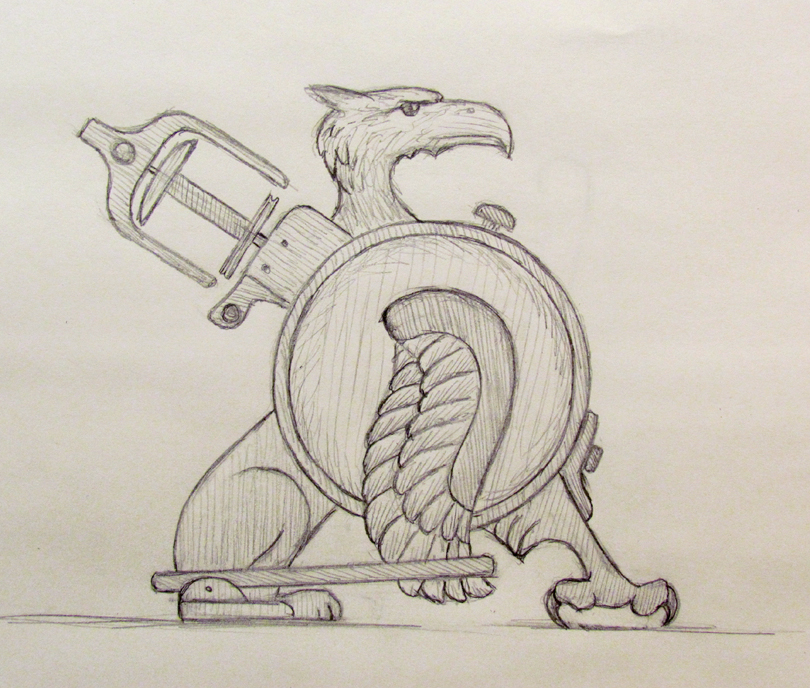 The next wheel I will be building is for Tina, who likes griffins. I never have thought about griffins much but after a little snooping around on the internet, I am getting eager to start building! I just sent Tina an e-mail with this drawing and told her I would be sharing the fun design process with others who check our blog. Here’s the plan:
Tina very much like the handles I’ve made on dragon themed wheels and suggested I change it to the griffin. So even though mechanically the latest wheels are more sophisticated, the idea still works. Now comes some really new things! Instead of making the wheel as a surface to carry art, I wanted to make something that has the feel of a cross between a griffin and a spinning wheel. Since the griffin itself is a cross between a lion and an eagle, this seemed a pretty logical extension of that idea. So this griffin is sitting and the lion’s body and back legs become the frame at the spinner’s end of the wheel. Extending from the front won’t be my usual single leg but will be two legs with the eagle’s clawed feet carved from wood. Both of these ideas are brand new and I will need to be at the top of my game to pull them off. The most interesting thing in this plan, however is the relationship between the main wheels and the pitman rods. On all other wheels the main wheels have become a great surface for some type of art, whether it be carving or painting. The pitman rods have been designed to be second level players, though they are shaped elegantly and thoughtfully. On this wheel those rolls are reversed! The pitman rods become the wings of the griffin and are elaborately carved and painted in a somewhat Egyptian style. Tina loves blues and purples so I think that is the direction I’ll go toward – with some metallic powders for a bit of flash and drama. The big wheels will become artistically a background. Mechanically they are still the heart of the spinning wheel.
So, that’s the plan right now. I do need to figure out a way to include the lion’s tail. Any ideas out there?

My adventures as a wheel maker are full of challenges and certainly this one is unique. Throw out all concern with accurate anatomy and just have fun. It gives me a strange and delicious freedom! This first picture shows how I made the little mouse. I turned the body and head on the lathe and inserted brass rods for the legs and arms. For a while I thought I was in a little over my head but I think the result is just right.

This photo shows the right side of the wheel with the little carved mouse on the handle. I decided to have the mouse face the spinner so he can sort of conduct all activities. Everybody needs a little direction after all. The paintings on the big wheels are based on early cartoons of these characters but I modified them to avoid copyright concerns. I really enjoy the vintage look of the art . The accent wood is padouk, and its rich red color goes well with the cherry.

This photo just shows what the other painting looks like. Notice the tuning pegs are padouk too. Also, the small space directly above the treadle has a little painting of insects playing instruments.

This photo shows the mouse from the spinner’s point of view. With a cheerful little helper like this what could go wrong? There is still a fair amount of work to do such as the speed change mechanism and flyer but most of the major woodwork is at least in place. Thought you might want to see. Enjoy!

The goat wheel is now on its way to Quebec and I am onto another project. CZ is a lifelong musician, music teacher, conductor as well as being a fine gourd artist. She and I have been dialoging about a new wheel that has a music theme about it. Being an idea person, she sent me a regular blizzard of ideas and photos once I suggested that she could have all the input she wanted. I eventually had to narrow the scope and just get started. As you can see from the photo this wheel has a front foot crafted to remind one of the neck of a violin. There is a little pegbox and in the four holes I will put tuning pegs made from exotic wood. I may put brass wire on them and they may travel up the leg for a bit. Too bad its so far away from the scotch tension! It would be fun to make one of these pegs have a function. The treadles have a fun cut-out that I feel adds a lot of elegance to the design. The really exciting part is yet to surface but I’ll tell you where we are headed. Remember those very early cartoons with animated figures playing instruments? I’m thinking ducks and mice and cows and dogs…… We are after a vintage look and I will get to try my hand at entirely different critters than the usual sheep, dogs, goats, rabbits, and cats! Will add posts soon!

For me one of the most exciting parts of my wheels are the parts that no one ever sees. All through this last year I have been upgrading my original design and making it more user friendly. This photo shows how the frame looks without the large wheels covering things up. Between the goat’s head at the top and the main frame at the bottom is the new assembly. It pivots and this allows the spinner to easily adjust the orifice height by just loosening and then re-tightening a knob. Another knob, seen protruding through the new assembly and exiting right below the goat’s chin, secures the speed changing assembly to the desired location. By moving this sub-assembly in or out the speed of the bobbin and flyer is changed. What appears to be a handle on the left end of the speed changer is actually where the scotch tension knob will fit. All this may seem pretty obscure to spinners but for me this marriage between function and clean flowing lines is a real source of satisfaction. I kind of hate to put the wheels on!

I couldn’t resist taking another photo of the goat now that I’ve finished the eyes. I carve the eyes, paint them, sand, re-paint, and when everything looks good I carefully and with a toothpick apply a dollop of clear epoxy resin. I keep holding the head at different positions while the epoxy sets to ensure a domed look and this whole step really makes the eyes come alive. I’m curious as to what name Christine will give this fellow! Below the head you can clearly see the knob that secures the speed changer.


Christine from Quebec is next on my work list and we have had a good and productive time collaborating on a new wheel celebrating her French Canadian heritage. It was fun to take the ideas she sent and find a way to incorporate them into this new wheel. Of course I am probably less than half way through the process but I believe this is a very good start. Christine has a couple of angora goats and I wanted to use a goat for a figurehead/handle. The trick was how to suggest such a wild and luxurious coat in wood that cannot be carved into fragile locks. I have made some compromises but it is coming along pretty well. Still some work to do on the eyes and face but at least it fits onto the wheel in a goat-like way. Christine also mentioned the arrow sashes worn by the voyageurs and that are still being proudly made and worn. I found these to be quite captivating and felt that a design painted around the big wheels would be a good way to carry on this tradition in a new way. There are a couple of other ways to add themes that follow her thoughts and I’ll put up photos as work progresses. I do think I’ll keep the wood light in tone. It seems to have a freshness I find very appealing. Thanks for looking!
 Olympic Spinning Wheels